

[2014.04.16] 清華大學腦科學團隊用雷射操控求偶行為中果蠅的特定腦神經細胞
【國立清華大學新聞稿】
清華大學腦科學團隊用雷射操控求偶行為中果蠅的特定腦神經細胞
國立清華大學腦科學中心的跨領域研究團隊,集結了奈米工程與微系統研究所暨動力機械系的傅建中教授團隊、電機系暨光電工程研究所林彥穎研究員、以及生命科學系江安世教授團隊三方的合作,利用全新發展的即時影像分析控制暨雷射追蹤系統,及光敏蛋白基因轉殖技術,能夠精準的激發果蠅腦中特定神經訊號的傳遞,並同時訓練果蠅在短時間內產生長期記憶。這項研究結果發表在2014年4月8日的美國國家科學院院刊(PNAS)上。 互動是動物建立社會結構的方法,而男與女之間的互動,則是傳宗接代不可或缺的一環。情人節我們互相送禮,結婚的時候我們用戒指套住對方,吵架的時候我們儘量保持距離,但最終都希望能夠手牽著手走在一起。果蠅的體積相較于人類雖然非常的微小,但是公母果蠅之間的互動卻非常的細膩。公果蠅在追求母果蠅的過程中,從唱情歌,跳舞,調情,追逐等等都是公果蠅要成功把母果蠅追到手的必要條件。而在交配結束之後,母果蠅又會因為要保護子代而拒絕下一隻公果蠅的追求。還有研究指出,被拒絕後傷心欲絕的公果蠅相較于一般公果蠅會更喜歡酒精。這一連串精巧的互動,讓科學家認為我們可以藉由研究果蠅的互動關係,以及了解果蠅大腦神經是如何調控這些活動,進而了解我們的大腦是如何讓我們能夠藉由自身的經驗來調整行為,以建立在團體中良好的互動關係。 果蠅求偶時的互動瞬息萬變,過去科學家只能先錄影再觀察分析。要理解果蠅大腦神經如何做出決定並改變行為,科學家要能以第三者的身份即時介入正在打情罵俏的果蠅配偶之間。清華腦科學團隊利用所發展的機器視覺暨雷射追蹤系統,在互動的求偶行為當中,即時分析兩隻果蠅多項行進中的參數,並且回饋給電腦監視系統,控制雷射來操控果蠅。研究者在公果蠅靠近母果蠅求偶時以藍光雷射激發其痛覺神經元,訓練公果蠅產生違反天性的迴避行為,並且產生長期記憶,至少一天之內都不會想再度靠近對方。在學習的過程中公果蠅展現了過去只在哺乳類動物中發現的主動式學習,在不斷被雷射責罰的過程中,公果蠅會因為被雷射責罰而逐漸主動降低接近母果蠅的次數。利用這套機器視覺暨雷射追蹤系統,科學家將可系統性的測試基因與腦神經網路如何操控複雜的動物行為。 本研究的重要意義在於透過生命科學、工程、電機等跨領域多方合作的結果,使得臺灣科學家領先全球首次能在公母果蠅皆自由行動的環境中,利用雷射針對特定的果蠅求偶行為進行控制,足以顯出跨領域合作的重要性。在未來,清大的腦科學研究中心將擴大有特色的跨領域合作,深耕培育具國際競爭能力的跨領域人才,持續突破在生命科學領域中許多未解的難題。
Remote control brain activity in fruit flies with automated laser tracking
An automated laser tracking system to manipulate brain circuits (ALTOMS) for studying social memory in fruit flies (Drosophila melanogaster) has been developed by an interdisciplinary research team in the Brain Research Center at National Tsing Hua University. This work appears on the 2014/4/8 issue of Proceedings of the National Academy of Science of the United States of America (PNAS). Scientists who conducted this work include a research group led by Dr. Chien-Chung Fu from Power Mechanical Engineering Department and Institute of NanoEngineering and Microsystems, a research fellow Yen-Yin Lin from Department of Electrical Engineering and Institute of Photonics Technologies and a research group led by Dr. Ann-Shyn Chiang from Department of Life Science and Institute of Biotechnology. This work used high-intensity laser irradiation as an aversive stimulus. Such a laser tracking system can be utilized for an operant conditioning assay in which a courting male rapidly learns and forms a long-lasting memory to stay away from a freely moving virgin female. It is remarkable while fruit flies may be “primitive” as compare to human beings physiologically, their interactions between male and female spices bear great resemblance to human male-female interactions. For instance, two lovers present gifts to each other on Valentine’s Day, keep away from each other when they disputes arise, and place wedding rings on each other when married. Even tiny creatures like fruit flies know how to flirt with one another. Male flies would sing love songs, dance and chase virgin female flies to “win her heart.” After mating, female flies would reject other males’ courtship. Interestingly, rejected male flies are more likely to become alcoholic than naive male flies. Scientists believe that studying these sophisticated interactions in flies could pave way to understanding how we as humans would shape our behaviors according to our past experiences to fit into the society. Thus far, fly social behaviors are studied through analysis of pre-recorded video. New tools are needed if we want to interfere flies’ behavior during their fast interactions. To understand how neurons process signals during social interactions, scientists at National Tsing Hua University have developed an automated laser tracking and optogenetic manipulation system to analyzes different parameters of flies’ behavior and manipulates neuronal activities via laser irradiation in real-time. Activating the pain neurons in a male fly whenever it courts near a female, the male quickly learns and forms long-lasting memory to avoid the female. This is the first demonstration of operant learning in flies since the male decreases the frequency of courting during training. In another word, the male flies effectively learn to control the initiation of laser irradiation. By using ALTOMS, the puzzle of how genes and neurons control social behavior will be lit up in the foreseeable future. The success in building ALTOMS to manipulate neural circuit in two freely moving flies for the first time in the world is a mile stone of interdisciplinary research in Taiwan. Committed to cultivate next-generation top scientists, the Brain Research Center at National Tsing Hua University will continue to emphasize interdisciplinary collaborations to uncover mysteries of life.
發表論文
Wu MC, Chu LA, Hsiao PY, Lin YY, Chi CC, Liu TH, Fu CC, Chiang AS (2014) Optogenetic control of selective neural activity in multiple freely moving Drosophila adults. Proc Natl Acad Sci USA 111, 5367-5372.
Macintosh HD:Users:chujulian:Desktop:51.tif
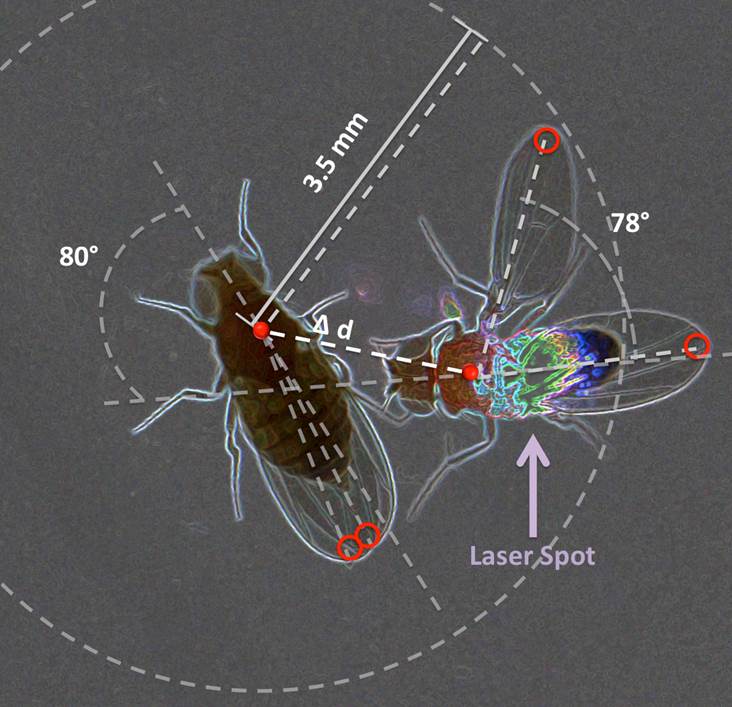
果蠅禁制令:圖片中為一隻公果蠅正在追求一隻母果蠅,被藍光以及黃光雷射同時照射。我們發展了一組即時影像分析暨雷射追蹤系統用以研究果蠅社交行為相關的記憶。當接近母果蠅的時候,公果蠅會被強雷射光驅離 (處罰),對這樣的經驗產生長期記憶,進而違反天性的遠離處女母果蠅,類似於人類的禁制令。此系統裝載了即時影像分析以及雙光雷射,讓科學家在未來可以研究主動式學習與社交行為相關的神經網路。
Restraining order in fruit flies: Pictured are two freely moving fruit flies, a courting male irradiated simultaneously by a blue laser and a yellow laser when encountering a virgin female. Wu et al. developed an automated laser tracking and optogenetic manipulation system for studying social memory in fruit flies. They designed an operant learning paradigm in which a male fly was trained to follow an invisible "restraining order" by being punished upon violating the order. The trained male quickly learns and forms a long-lasting memory to stay away from the virgin female. Given its capacity for online analysis of flies' movement and optogenetic manipulation of target neurons, this new laser tracking system offers opportunities to systematically map brain circuits orchestrating specific fruit fly behavior. Macintosh HD:Users:chujulian:Documents:Fly arena paper:PNAS manuscript:Movie for news:pic for news.tif
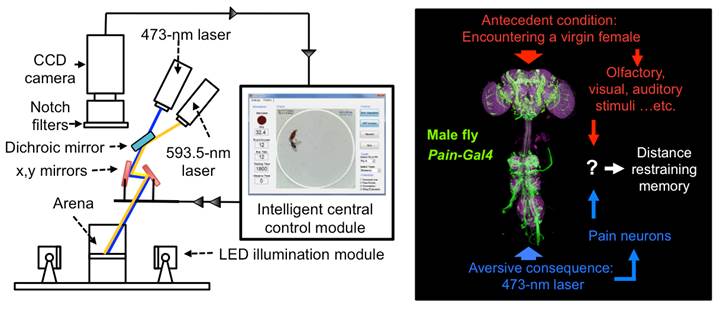
ALTOMS是一組全新的及時影像分析暨雷射追蹤系統,其中包含影像分析模組,智慧型中央管理模組,雷射掃描模組以及果蠅競技場。我們利用這套系統進行了一套全新的主動式學習實驗。研究者能夠在公果蠅求偶的特定階段激發果蠅腦中痛覺神經元,用以研究訓練果蠅產生違反天性的迴避行為,並且在一天之內都不會想再度靠近對方。其中公果蠅在學習的過程中展現了過去只在哺乳類動物中發現的主動式學習,在不斷被雷射責罰的過程中,公果蠅會因為被雷射責罰而逐漸主動降低接近母果蠅的次數。由於此系統裝載了即時影像分析以及雙光雷射,讓科學家在未來可以研究與社交行為相關的神經網路。
ALTOMS is an automated laser tracking system that comprises four parts: an image capture module (ICM), an intelligent central control module (ICCM), a laser scanning module (LSM), and a fly arena. This allows the development of an operant learning paradigm in which a male fly was trained to follow an invisible “restraining order” by being punished upon violating the order. By optogenetic activation of specific neural circuits during social interactions, we found that pain neurons in the male fly signal aversive consequence to the brain where it associates with the antecedent condition of encountering a virgin female. ALTOMS offers opportunities to systematically map brain circuits that orchestrate specific behaviors in fruit flies.